Teaching Children An Attitude of Gratitude
Seeing God's Provision in the Ordinary Rhythm of Life
Your financial support makes resources like this available! Give now!
It was the end of a long day celebrating her fourth birthday—swimming, eating lunch at her favorite restaurant, and receiving many gifts, including a new bike! Yet she cried, telling her mom how disappointed she was. Her expectations of what the day would hold hadn’t come true.
Your first thought might be, How ungrateful and spoiled! But that isn’t the case. She is a sweet, precious, and kind girl.
Driving home, I was reminded that sometimes I am like her—ungrateful for the blessings God has given me and disappointed when He doesn’t live up to my expectations.
It got me thinking of the basic values of faith and good works that Christian parents and teachers seek to instill in our children.
But I began to wonder why I haven’t been more intentional about practicing an attitude of gratitude—and teaching it to children—when you sit at home and when you walk along the road, when you lie down and when you get up, as Deuteronomy 6:7 instructs.
How might we develop an attitude of gratitude and teach it to our children as we sit, walk, and lie down—making gratitude part of the ordinary rhythm of life and becoming more mindful of our blessings?
This requires more than telling children, “Be thankful.” We must first model gratitude by pointing out God’s blessings and speaking them aloud in prayers of gratitude as we move through our day.
What might that look like?
Waking up? Thanking God for the bed you slept in.
Seeing a sunrise? Thanking God for eyes to see.
Breakfast on the table? Thanking God for full tummies and a digestive system that turns food into nourishment.
Music playing? Thanking God for ears that hear.
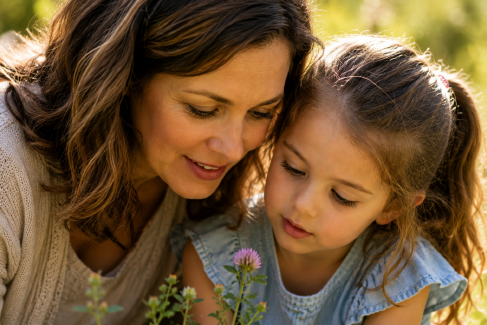
Holding a flower? Thanking God for a nose that smells the sweet scent!
David begins Psalm 23
with these familiar words: The LORD is my shepherd; I shall not want. What a beautiful picture of gratitude and trust! Because the Lord is our Shepherd, we can rest in His faithful care and provision. “I shall not want” doesn’t mean we will have everything we desire or that life will always meet our expectations. It means we can trust our Shepherd to know what we truly need and to faithfully care for us.
The list of blessings is endless. But intentionally pointing them out will not only make us more mindful of our blessings; it will also help the children in our care become more mindful of theirs. Gratitude isn’t merely good manners we’re teaching children; it’s something we practice until it changes the way we see what God has already given us.
This doesn’t mean we’ll never be disappointed again, but hopefully it will retrain our hearts to recognize just how deeply we are loved by God:
He who did not spare His own Son, but gave Him up for us all, how will He not also, along with Him, freely give us all things? (Romans 8:32)
How might you model gratitude to others? Drop
your comments here.
Share this with a teacher and friend!
Copyright 2026 S.A. Keith
Help keep the site going, support our site!
Subscribe to our Newsletter - Learn More